Cognitive training
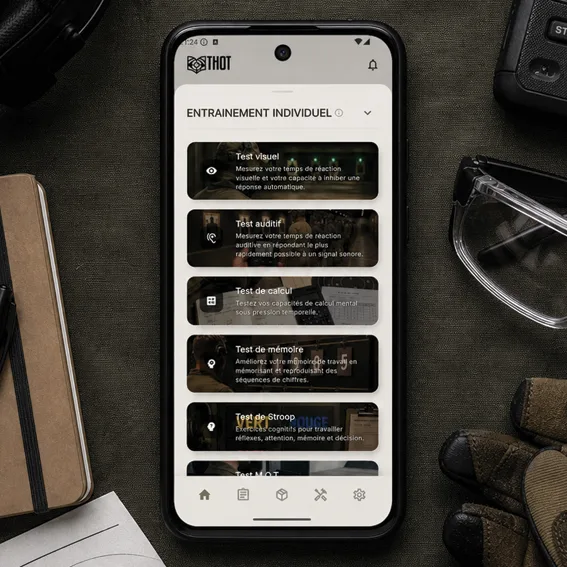
Seven cognitive training protocols, inspired by paradigms used in research on attention, working memory and decision-making under time pressure. Each one progresses across 50 difficulty levels, from a simple warm-up to the most demanding exercise.
WarningThese exercises are not a medical device and do not replace any clinical evaluation.Results (scores, reaction times, success rates) are strictly indicative and must not be used as the basis for a medical, professional, or operational decision.
01 · Visual reaction
A Go/No-Go exercise: react as fast as possible to a "go" visual stimulus, without reacting to a "no-go" one. Difficulty grows with the number of stimuli (8 to 30) and shrinking delay windows.
A classic simple reaction time paradigm, studied since Donders' work (1868) on mental chronometry; the Go/No-Go variant, formalized in the 1960s, is now a standard response-inhibition test used in attention assessment.
02 · Auditory reaction
Same principle as the visual exercise, applied to sound: react as soon as the audio signal sounds.
Auditory reaction time is on average 30 to 50 milliseconds faster than visual reaction time, since the auditory pathway requires shorter neural processing — a gap documented since Donders' foundational work (1868).
03 · Mental math
Solve as many operations as possible in a limited time (45 to 120 seconds depending on level); operators progressively grow more complex, from addition/subtraction up to division.
Exercise inspired by the fast mental arithmetic protocol popularized by Japanese neuroscientist Ryuta Kawashima (Tohoku University), whose prefrontal cortex activation has been studied in several cognitive stimulation papers.
04 · Memory / digit span
Memorize a briefly displayed sequence of digits, then reproduce it in order. Sequence length (3 to 12 items) grows with level, while display time shrinks.
Inspired by Wechsler's Digit Span test (1939), a historical component of the WAIS and WISC intelligence scales, and by the Corsi Block-Tapping Test (1972) for the visuospatial dimension — a reference measure of short-term working memory.
05 · Stroop
Identify the ink color of a word, without being distracted by the word itself, which often names a different color. Three difficulty tiers.
Developed by John Ridley Stroop in 1935, this test is today one of the reference tools of clinical neuropsychology (D-KEFS, Golden Stroop batteries) for measuring inhibition and selective attention.
06 · M.O.T. (Multiple Object Tracking)
Spot several targets among a set of identical shapes, then track them by eye as they move and intermingle, before identifying them once stopped. Target count (1 to 6), movement speed and tracking duration grow with level.
Based on the Multiple Object Tracking paradigm, introduced by Pylyshyn and Storm in 1988 and since studied in contexts of very high performance, notably sport and military (Vartanian et al., Military Psychology, 2016).
07 · Attentional dissociation
Keep a steady tapping rhythm while reacting to Go/No-Go stimuli appearing in parallel — a dual task that engages divided attention. From level 21 onward, the rule can flip mid-exercise, to train fast adaptation.
Inspired by dual-task and task-switching paradigms used in cognitive psychology, aviation, and attention-load training for elite athletes.
Each protocol progresses across 50 levels: difficulty (speed, number of distractors, reaction windows) automatically adapts to your progress.
Visual reaction is included in the free plan; the other 6 protocols are part of THOT Pro.
Training, not a game
Grounded in recognized research paradigms, this module remains a personal training tool — never a substitute for medical or clinical advice.