Tools
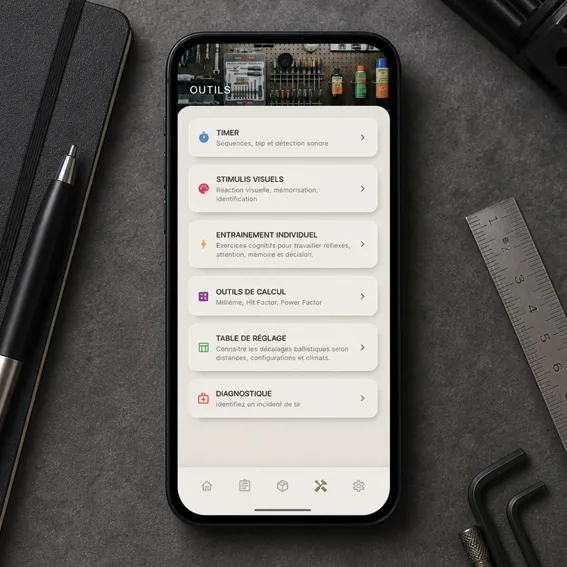
Beyond the logbook, THOT ships a suite of tactical tools built for the range: precision timing, field-measured adjustment tables, ballistic calculations and incident diagnostics. None of them need a connection.
Shot Timer — 6 trigger modes
The THOT timer covers the standards of timed shooting and tactical training: simple countdown, Par time, repeats, random beep, sound-detection chronometer and multi-hit mode. Fine-tune the start delay, cycle duration and detection sensitivity.
Countdown
A start signal after a configurable delay. The reference mode for solo practice.
Par time
A start signal, then an end signal after a window fixed in advance — the classic timed-shooting format.
Repeats
Automatically chains several identical cycles, to repeat a drill without resetting the timer by hand each time.
Random beep
The start signal fires at a random moment within a defined window, to train pure reactivity with no possible anticipation.
Sound-detection chronometer
The phone microphone detects the first shot and stops the chronometer automatically, with no button to press.
Multi-hit
Like the sound-detection chronometer, but each detected shot is timestamped individually: first-shot time, splits, average, standard deviation.
The microphone is used only on-device to detect sound peaks. No audio is recorded or sent outside the app. Detection performance may vary depending on the range and platform used.
Countdown and Sound-detection chronometer are included in the free plan; the other 4 modes are part of THOT Pro.
Adjustment tables — measured in the field
A THOT adjustment table is not a theoretical calculation: it's a log of readings you enter yourself, distance by distance, with the horizontal and vertical corrections actually observed on the range.
Trust data verified on your own gear, ammunition and real conditions — not a generic chart.
Each table can be exported as a QR code or a text code, to hand it to another shooter or retrieve it on a second device. The exchange never goes through a server: the code only contains this table’s data.
Adjustment tables are part of THOT Pro.
Calculation tools — Mil, Hit Factor, Power Factor
Three field calculators, usable offline and included in the free plan.
Mil
Distance calculation using the mil formula, based on the apparent size of a visual reference in your scope. A library of everyday references is built in (human silhouette 1.8 m, head 0.25 × 0.18 m, light vehicle 1.5 × 4.3 m, truck 3.5 × 12 m, pylon, door, window, tree, house) to estimate distance without a rangefinder.
Hit Factor
The performance metric used in IPSC dynamic shooting: the score achieved (A/C/D zones, Miss and No-Shoot penalties) divided by total time, to objectively rank a stage performance.
Power Factor
Classifies ammunition power from muzzle velocity and bullet weight: Power Factor = (velocity in fps × weight in grains) ÷ 1000. Usual thresholds distinguish Major, Minor and Sub-minor — always check your division’s rulebook.
Incident diagnostic — guided analysis, not a replacement
A firing incident — failure to fire, delayed discharge, feeding/cycling issue, accuracy loss, involuntary discharge — deserves a methodical analysis before any hasty conclusion. THOT's diagnostic always starts with a mandatory safety phase (safe direction, finger off the trigger, platform state) before asking a single technical question. It covers 5 incident categories and refines its estimate through a series of targeted questions, ending in a weighted probability of the most plausible causes — ammunition, fouling, adjustment, internal wear, optic, human factor.
WarningDoes not replace an inspection by a professional gunsmith.If in doubt, if the incident repeats, or if behavior seems abnormal, stop use and have your equipment inspected.
The incident diagnostic is part of THOT Pro.
The range, without compromise
Timer, tables, calculators and diagnostics: tools built to be used under pressure, offline, without ever leaving your pocket.